Wednesday, 17 November 2010

Village Schools 3: Srey lin

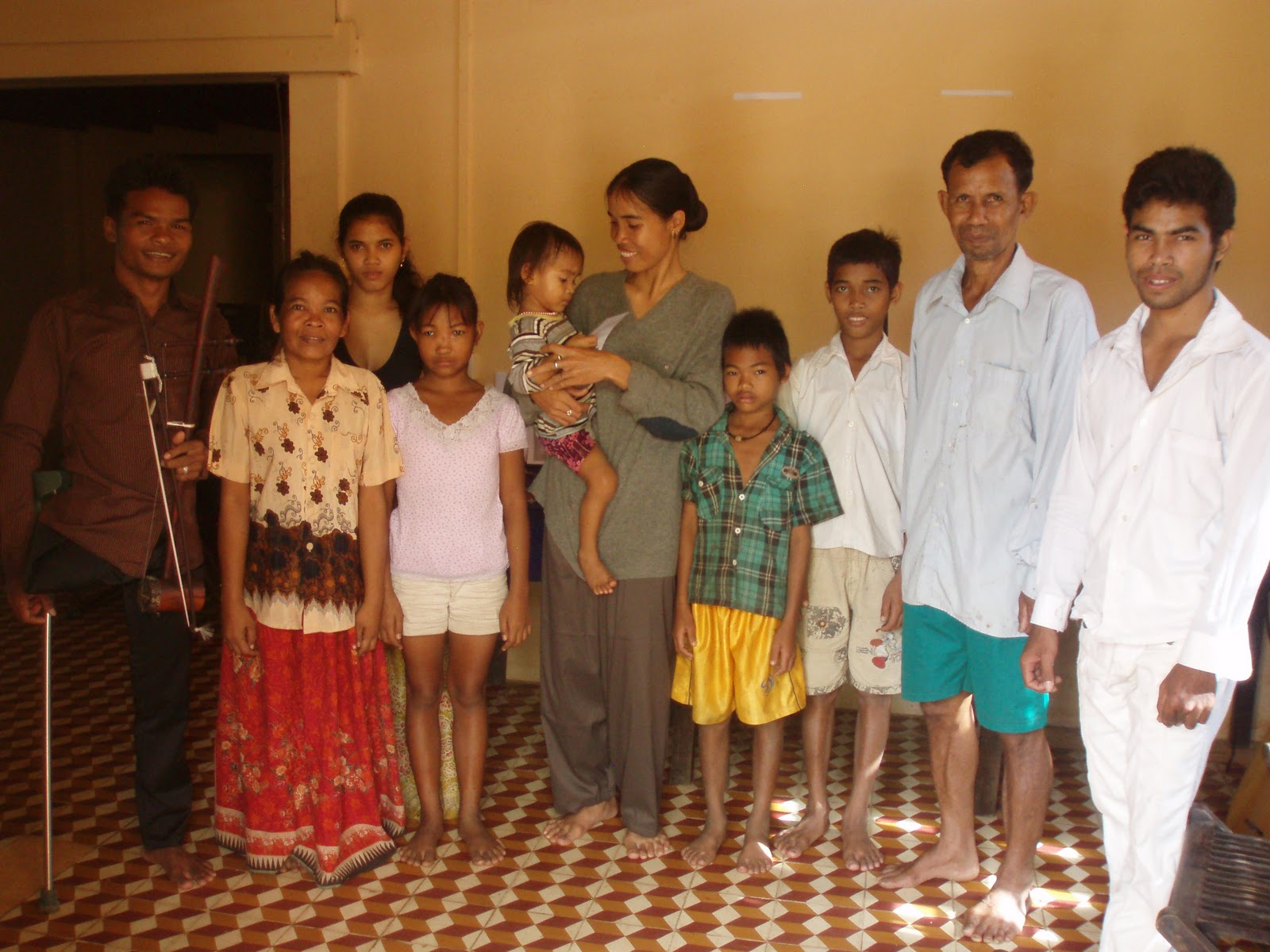
Sreylin is very nervous when we arrive at her school. Soon we laugh her nerves off. We go through her lesson plan, then meet some members of her family. Her school is at the heart the Preh Dak village where she and Phalla are from. It is  built on the land of her house and is the village school closest to the Pagoda. Preh Dak is an ordered and beautiful village houses (huts) with rows of Cambodian houses on stilts.

Sreylin apologises for the dunk smell, which I had not really noticed until that point. The school is next to the open stable where her two buffalos rest. One of them is badly injured so she has to collect grass for him every morning from the fields to feed him. I can see that his injury upsets her very much. There are not many vets here so she hopes that the buffalo gets better and can walk again. But she fears that this might not happen.

As the village school is easily accessible the class is very busy, despite the earlier rain and muddy roads. Sreylin is one of the most methodical teachers. She is very nervous but actually her English is a lot better when she teaches rather when she is taught. She comfortably steps up to the challenge of teaching. Some people are simply tuned to be teachers and she seems to be one. I am so proud to watch her as she incorporates a spelling game in the lesson, homework check and a couple of songs. She also seems to have taken on board lesson planning, teaching tips and much of what we have learned and practiced. Towards the end of the lesson things get tougher for Sreylin as her whole family and some villagers have gathered around the class to watch her. It must be unnerving and we are all getting tired.

My day ends with some time with Srey lin and her family. Phalla plays translator but in reality not many words are spoken. Like the aspara dancers we perform this scene of interaction with gentle body movements and meaningful glances so that nothing gets lost.  I watch Sreylin’s mother quietly admiring her daughter. And that just that fills me with joy.

This grass roots community project is growing its own teachers. It is giving its own young people the opportunity to develop skills through practice, training and our small contributions, assistance, training. An opportunity that some of them might not have otherwise had. The project also gives the community the opportunity to marvel at its own strength and potential. I came here persuaded but as time goes by I grow more and more convinced that this is the way that skills should grow, from the roots like nature intended.

Thorny politics and tabús

In Cambodia there are some different accounts of the Khmer Rouge events than the one widely recorded. This has been described to me as ‘an uninformed viewer’s’ perspective but then in reality it is an oral account of the events from some of the local people’s subjective perspective.  If even in Cambodia, you might want to prepare to challenge your western pro democracy beliefs (as Lucy very well describes the way most of us have grown up). I had to carefully manage the feelings that some of the discussions evoked, be insightful and open minded.

One of the biggest challenges has been to see people idolise the Khmer Rouge and reminisce in its egalitarian principles. I deliberately did not read about modern Cambodian history in much detail but was aware of the main events, key political figures and observations as recorded by foreign historians. The events are very complicated. But I was, perhaps naively, baffled by some people’s affinity to the Khmer Rouge. Even more surprising is that some of these people are in their thirties or younger. Young adults who have no memory of the era and who interpret the facts as relayed to them by their family and close circles. Or perhaps this is not surprising at all.

It has not been easy to digest, particularly as I then came across some other people like Sopiah who had a different informed opinion through working at the Cambodian history documentation office. To understand this internal national conflict, this contradiction, you have to remind yourself that history does not seem to be taught at Cambodian schools and current teenagers are the first generation to which English is widely taught. This gives them future access to international accounts of the events for the first time. As many people tell me here Cambodians have not had access to a lot of the information internationally available because of language and education barriers. Annie, an informed English Language teacher, who has lived in Cambodia for ten years, also believes that the Cambodian reaction I observe is a national coping mechanism. Having gone through bereavement and grief myself I can relate to this and fully understand the analogy.

The Khmer Rouge era is a thorny subject, almost a tabù. Some people tell you that the killings have not happened whilst facing the victims’ skeleton shrines. I would have to dedicate a few months if not years to the subject to really look into it and be in a position to challenge oral history and accounts.

There is something else to bear in mind. I say what I about to say mustering all the understanding and objectivity I can find within me: historical events are subjective accounts to a certain extent and are experienced differently by individuals and their families. They have a different impact and consequences on different groups and individuals.  Historical interpretations can be fabricated and powerful media or international politicians can legitimise one account over another.

I have to remind myself about the Greek civil war and how it tore my father’s family apart. It was a time that uncles nearly killed nephews in the dark forests or if you want to name people kill my own 10 year old father. Atrocities committed in the name of a leader of a political ideology never impress me. And what angers me sometimes is that nations can be acting out a scenario created by masterful puppeteers, in international political and economic growth ploys a lot bigger than their national reality or concerns.

We can all pick a side in historical events but does this make our choice right?  And is it not a lot easier to do this when you are detached from this event as it does not take place in your country? It is easier to condemn other people’s mistakes or actions than your own.

So whilst I am instinctively averted by the Khmer Rouge events and the evidence I can see, I have no intention to impose my views on anyone. I also think I need to do a bit more research to be informed.

I have reaffirmed one thing today: I will continue to judge people by their actions and not their statements and political opinions.  Look at some of the self righteous westerners and their states condemning and taking positions in the media yet subversively intervening in historical events and committing silent atrocities through their continuing colonialist behaviour in the name of capitalism and self interst.

Sopanha's place

The cook and I
At Sopanha's
Sopanha and Koosh
Siem Riep can definitely offer culinary indulgence. There are many classy restaurants with delightful dishes, amazing decor and excellent service. But the standard of food is usually excellent in smaller and reasonable places and avant guarde restaurants. Apart from the rare occassion, I have preferred to savour the home cooked dishes of road side cafes and particularly of small, family run restaurants. One of the best restaurants I have dined at in Siem Riep is Arun Restaurant where Ming Pow nourishes her visitors. This is the restaurant behind which my room was placed.

Another great place is Sopanha's on 12D Mondul Svay Dangkom. Sopanha is a lively and passionate man. His English is impressively good as is his knowledge of Cambodian's history (at least this is the impression he gives me). As well as running a small restaurant he is a tourist guide. Sopanha’s family suffered the consequences of recent historical events in Cambodia. His is a different perspective: he used to work with the office of national documentation (apologies for the most likely incorrect term), so he has seen evidence of the killings that took place during the Khmer Rouge regime. Combined with his family experience he is one of the people who perhaps as a Cambodian is better placed to give you an accurate introduction to the historic events that took place in Cambodia at the end of the seventies. So I would visit him or contact him to take you around places if you ever find yourself in Siem Reap.

This unpretentious small restaurant can be found opposite the11th January High school and offers me a fantastic  traditional lemongrass soup. The food is cooked by Sopanha’s wife. He has 7 women running this place with him. Some are daughters, some are nieces.  There are a couple of boys running out to school in a rush. As I am waiting for Phalla I indudge in Sopanha's company.  We talk excitedly.

As Phalla’s ‘hello kitty’ car (there is a massive hello kitty sticker in the middle of the back window), stops to meet me outside Sopieh’s, the torrential rain gets heavier. It is welcome and refreshing on this muggy day. It has actually been raining every day since the beginning of this week but usually in the late afternoon or at night. In these conditions, Phalla’s little car transforms into a mini 4x4 as we turn into muddy dirt tracks with large pools of water.  Water gets into the engine and I pray we make it to our destination. But I should have no fear, there are numerous lucky charms blessed by the monks adorning the CCHA vehicle. In any case Phalla keeps crossing the water pools fearlessly and despite the smoke coming from the engine! Somehow it all works and  we get to the Pagoda school in time.

Tuesday, 16 November 2010

Female Solidarity

There is much I don’t have time to write about. I hear, see, think and note so many things here. Cambodia is a contradiction: beautiful, stubborn emerging and performing a balancing act on the tight rope that is its future. I have begun to see ‘her’ for who ‘she’ is and to love ‘her’ for that.

Cambodia is feminine. There is no doubt about this. Koosh makes this observation in one of our discussions (in the few instances that we have met, me and Koosh have beautiful poetic discussions like ancient philosophers). Women are indeed the backbone of Cambodian society. With their composed manner they steer , guide and lead inconspicuously.

There is something else I notice about the women here. They seem comfortable in their skin and content with themselves. One of the differences between our western and this (the Cambodian) society is the authentic and unpretentious female solidarity I observe in day to day life. There is absence of spiteful antagonism and envy. Women don’t measure themselves against each other here but they take account of their collective strength.

I think at times that women in the West are becoming more masculine by the day. Feminism, empowerment, liberation and equal rights in employment and society are gifts that previous generations have given us. But are we misinterpreting and misusing it today? What are we struggling to prove?  Like boys I see women competing against each other. They have entered a world of mud wrestling, a fight to prove their worth, struggle for their physical attractiveness usually discontent with what they see and not being thankful for their most beautiful features. Someone is waving a carrot in front of their nose. They fight for status, strive to be ‘male’ and a female at the same time (to have a career, to reproduce, to be the best lover, to be the best looking one). They envy. They waste energy and time.  And I don’t think that they even realise this half the time. All this has saddened me deeply as an observation.  I will not lie to you: at times it has had a devastating impact on my life. I am comfortable in my skin and don’t have time for such exhausting and energy draining interactions.

Here I have not encountered yet sly flattery: women mean their compliments to each other and admire each other quietly and respectfully. They support each other and don’t use one another to progress their agendas and objectives stepping over each other. They are not threatened by each other.

As I chat with Chandra and her sister at Bel’s house, I feel this connection. There is a different sisterhood and solidarity between us, in the same way that there is between me and Ming Pow , the girls and women of the guest house I am staying at, in the same manner that I have this with my three female teachers and the women I encounter at shops, in the market, at roadside cafes in the countryside. Perhaps this is a naïve observation and a sweeping generalisation ( which I generally hate to make!); perhaps I have spoken too soon but perhaps my instinct is correct. This is my subjective view, the realisation has hit me quite hard from the first few days of my stay here, I have quitely digested and pondered on it and I feel quite certain about it.  

Village Schools 2: Rom

In my first week I also visited four schools but I spent most of my timesworking with Phalla on other CCHA matters. I must stay that working at the schools with the teachers is one of the highlights of my work here. I am so pleased I am at a  village school again this evening.

Rom is a tall young man by Cambodian standard; a gentle giant with an endearing smile that makes you calm and serene. He is one of the teachers most reluctant to speak English but this is not because his knowledge suffers.

When I arrive at his school Rom is buzzing around me with energy. ‘Teacher, pronounce this for me please’ he asks, and we go through the words that he will teach today. Today we teach the sound of the long ‘I’ like in ‘ripe’. We also get the opportunity to practise sounds of consonants, like 'v', 'f' and 'd', which they all struggle with.

I am impressed by the respect this man commands with his gentle manner. I am impressed by how much love he transfers through his teaching. During the second lesson I get an unexpected present. Phalla joins in and I see him in action for the first time. Phalla is gifted, truly gifted. The class comes to life when he stands up skilfully combining the new lesson with old ones. ‘Rip’ and example for a short ‘I’, ‘ripe’ an example for the long ‘i’.

We finish after 7 but we are so energised. So we play the clapping game. The joyful laughter of the children fills the vast countryside surrounding the school. Gradually the people in nearby dwellings gather around us and applaud excitedly, willing us to continue. But again the children have to make their way home. It’s nearly eight.

As I sit in the car I am truly exhausted today. Phalla chats away and I just listen to the sound of his voice. I notice how much teaching centres, calms and energises Phalla. It a need that he has to satisfy rather than a job for him. Teaching is part of his nature. I ponder, Phalla narrates another story, the stars peak out,  locals wave on their bicycles, another day passes.  

A loving commune-Khmer Independent Life Team (KILT)

I meet Bel through Koosh at the Golden Temple Hostel one morning. Bel is the director and man behind KILT,  a commune of people suffering with physical disability, mainly cause by landmine explosions, polio and somtimes other diseases.  KILT's aim is to improve the quality of life, work opportunities, and social integration of Khmer (Cambodians) with disabilities through vocational training, education and work in a sustainable manner.  

On Tuesday morning Bel opens the doors of his home to me. He picks me up on a bike. Bel lost a leg in a landmine explosion at the age of seven. He walks and moves proudly in a manner that does not draw attention to his physical disability. I hardly notice it as he drives me on the motobike through the backstreet neighbourhoods of Siem Reap. In fact I feel safer than I did on my ride to the Kulen mountain.

KILT had 30 members at one stage. They all lived together in a large house supporting each other, making jewellery and musical instrunments, participating in community projects and endavours and giving musical performances! The commune membership is down to 9 members at the moment. The floods of the monsoons season in Cambodia have caused the commune to relocate twice, partly causing people to disperse. The other reason is that if KILT does not always make enough money to support everyone. So they have to pursue their own endeavours.

As I enter the humble abode of Bel, I am greeted by his beautiful wife Chandra. She suffers from polio related disability but it is impossible to make this out. Their 2 month daughter sleeps serenly in a hammock. A few other members of the commune are in the house.

The main income for KILT is through the making and sale of jewellery. I see some beautiful pieces made from reused material, coconut and Cambodian stones. KILT is also a group of musicians. Bel and I get down to business. I have been very impressed by the sound of the Cambodian instrunment 'tro'. That day I have my first private tro lesson. Bel has been practising the tro for  a year. I think I have a long way to go. But I keep trying!

I am impressed by Bel. He comes across as a persuasive young businessman. For all it's gentility and goodness Cambodian society is prejudiced against people with disability. They are not treated as employable. Bel and KILT introduces another way of doing things. They are not the only project. There are hundreds if not more of similar charities and projects. But what impresses me about this one is that is is run by the people it benefits, it does not create dependent members but offers them a skill and alternative lifestyle and is led by quite a respectable young man.

As I leave KILT with a tro in my backpack, determined to learn how to play it, I hope that KILT grows stronger and stronger.

For more information on KILT:


Monday, 15 November 2010

Village Schools: Sopiep


There is not one teacher or child that I am more fond of than another but I think it is good to give you a brief glimpse of our work  villages schools in this last week of mine in Cambodia. Every day after the teaching at the Pagoda and having my time with each teacher, I join in a lesson at a village school: to help, to observe, to advise, to play.

On Monday I am with Sopiep , one of the three female teachers. Sopiep is gentle and stern at the same ime. She exudes maturity but when she laughs she chuckles like a happy child. Today it rains heavily at intervals in impressive downpours. So many students have not travelled to the school. This is one of the schools that is remote and when the weather is bad attendance suffers. Sopiep is slightly embarassed but soon she relaxes as we jest.

There are five cheerful girls in our first class. Today we learn the sound 'ch' as in  the word 'child'.  We look for words in Khmer that help the girls understand and reproduce the sound. The name of teacher Chaya (another of my teacher students) is the most obvious and easy one to remember. So we practice, we learn , we laugh. 

There are two classes each afternoon between 5-7 at each school. At 6 we exchange one small class for another for the last hour of teaching. It is now really dark and Sopiep is keen to let the children travel back home. Some of them have to go a long way on foot in the dark.

'Thank you teacher. Good night and good luck for you .See you tomorrow', they chant in harmony.

Maybe not tomorrow, but 'see you soon'. And I intend to keep this promise.