Tuesday, 16 November 2010

Village Schools 2: Rom

In my first week I also visited four schools but I spent most of my timesworking with Phalla on other CCHA matters. I must stay that working at the schools with the teachers is one of the highlights of my work here. I am so pleased I am at a  village school again this evening.

Rom is a tall young man by Cambodian standard; a gentle giant with an endearing smile that makes you calm and serene. He is one of the teachers most reluctant to speak English but this is not because his knowledge suffers.

When I arrive at his school Rom is buzzing around me with energy. ‘Teacher, pronounce this for me please’ he asks, and we go through the words that he will teach today. Today we teach the sound of the long ‘I’ like in ‘ripe’. We also get the opportunity to practise sounds of consonants, like 'v', 'f' and 'd', which they all struggle with.

I am impressed by the respect this man commands with his gentle manner. I am impressed by how much love he transfers through his teaching. During the second lesson I get an unexpected present. Phalla joins in and I see him in action for the first time. Phalla is gifted, truly gifted. The class comes to life when he stands up skilfully combining the new lesson with old ones. ‘Rip’ and example for a short ‘I’, ‘ripe’ an example for the long ‘i’.

We finish after 7 but we are so energised. So we play the clapping game. The joyful laughter of the children fills the vast countryside surrounding the school. Gradually the people in nearby dwellings gather around us and applaud excitedly, willing us to continue. But again the children have to make their way home. It’s nearly eight.

As I sit in the car I am truly exhausted today. Phalla chats away and I just listen to the sound of his voice. I notice how much teaching centres, calms and energises Phalla. It a need that he has to satisfy rather than a job for him. Teaching is part of his nature. I ponder, Phalla narrates another story, the stars peak out,  locals wave on their bicycles, another day passes.  

A loving commune-Khmer Independent Life Team (KILT)

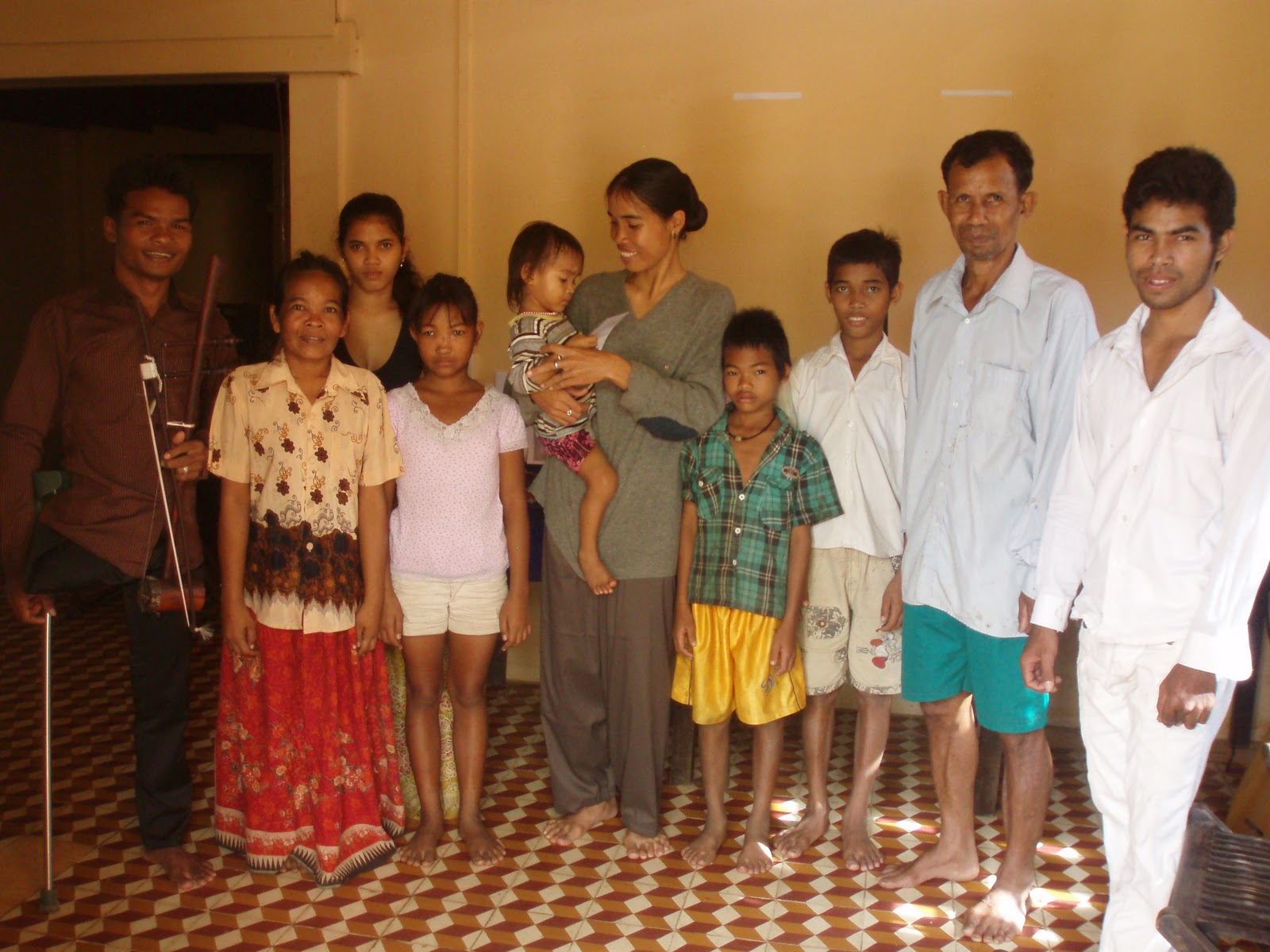
I meet Bel through Koosh at the Golden Temple Hostel one morning. Bel is the director and man behind KILT,  a commune of people suffering with physical disability, mainly cause by landmine explosions, polio and somtimes other diseases.  KILT's aim is to improve the quality of life, work opportunities, and social integration of Khmer (Cambodians) with disabilities through vocational training, education and work in a sustainable manner.  

On Tuesday morning Bel opens the doors of his home to me. He picks me up on a bike. Bel lost a leg in a landmine explosion at the age of seven. He walks and moves proudly in a manner that does not draw attention to his physical disability. I hardly notice it as he drives me on the motobike through the backstreet neighbourhoods of Siem Reap. In fact I feel safer than I did on my ride to the Kulen mountain.

KILT had 30 members at one stage. They all lived together in a large house supporting each other, making jewellery and musical instrunments, participating in community projects and endavours and giving musical performances! The commune membership is down to 9 members at the moment. The floods of the monsoons season in Cambodia have caused the commune to relocate twice, partly causing people to disperse. The other reason is that if KILT does not always make enough money to support everyone. So they have to pursue their own endeavours.

As I enter the humble abode of Bel, I am greeted by his beautiful wife Chandra. She suffers from polio related disability but it is impossible to make this out. Their 2 month daughter sleeps serenly in a hammock. A few other members of the commune are in the house.

The main income for KILT is through the making and sale of jewellery. I see some beautiful pieces made from reused material, coconut and Cambodian stones. KILT is also a group of musicians. Bel and I get down to business. I have been very impressed by the sound of the Cambodian instrunment 'tro'. That day I have my first private tro lesson. Bel has been practising the tro for  a year. I think I have a long way to go. But I keep trying!

I am impressed by Bel. He comes across as a persuasive young businessman. For all it's gentility and goodness Cambodian society is prejudiced against people with disability. They are not treated as employable. Bel and KILT introduces another way of doing things. They are not the only project. There are hundreds if not more of similar charities and projects. But what impresses me about this one is that is is run by the people it benefits, it does not create dependent members but offers them a skill and alternative lifestyle and is led by quite a respectable young man.

As I leave KILT with a tro in my backpack, determined to learn how to play it, I hope that KILT grows stronger and stronger.

For more information on KILT:


Monday, 15 November 2010

Village Schools: Sopiep


There is not one teacher or child that I am more fond of than another but I think it is good to give you a brief glimpse of our work  villages schools in this last week of mine in Cambodia. Every day after the teaching at the Pagoda and having my time with each teacher, I join in a lesson at a village school: to help, to observe, to advise, to play.

On Monday I am with Sopiep , one of the three female teachers. Sopiep is gentle and stern at the same ime. She exudes maturity but when she laughs she chuckles like a happy child. Today it rains heavily at intervals in impressive downpours. So many students have not travelled to the school. This is one of the schools that is remote and when the weather is bad attendance suffers. Sopiep is slightly embarassed but soon she relaxes as we jest.

There are five cheerful girls in our first class. Today we learn the sound 'ch' as in  the word 'child'.  We look for words in Khmer that help the girls understand and reproduce the sound. The name of teacher Chaya (another of my teacher students) is the most obvious and easy one to remember. So we practice, we learn , we laugh. 

There are two classes each afternoon between 5-7 at each school. At 6 we exchange one small class for another for the last hour of teaching. It is now really dark and Sopiep is keen to let the children travel back home. Some of them have to go a long way on foot in the dark.

'Thank you teacher. Good night and good luck for you .See you tomorrow', they chant in harmony.

Maybe not tomorrow, but 'see you soon'. And I intend to keep this promise.

Back at the Pagoda School: Cambodian Child and Hope Association (CCHA)

I have missed my students and on Monday morning I wake up really eager to see them. I have revision notes and plans for more interactive exercises and conversations. I see my role here as one of a discrete teacher that can perhaps inspire and sustain hope. I also contribute to the training the students on the delivery of a new curriculum.  Most importantly I spend a lot of time with the young teachers under a tree going through their lesson plans, advising them on improving lesson planning according to their needs, answering their questions and discussing engagement of the students. I am very fond of these young teachers and I really savour the time I spend with them individually. I learn so much from them.  My contribution is just piece added to CCHA puzzle – the picture is already outlined. But I am hoping that in my company Phalla has had a chance to take a breath , a step back and make out this picture . Marvel at its sight in relief.

When Phalla meets me he clearly has a lot on his mind. Running a project that requires so much devotion and effort cannot be easy but Phalla perseveres. The SAFE Foundation has given him essential support and he is hoping that more volunteers will follow to help the project. He tells me how the CCHA relies on donations for basic supplies such as notebooks, pens and new books.

Like many projects of its kind, CCHA has no guaranteed and constant funding. As I have said there are many worthy causes and charities in Cambodia, but the village schools of CCHA are tucked away in the countryside and don’t benefit from the donations of passing tourists. My humble opinion is that is important not to turn the schools and sites to tourist sites for the sake of raising some additional funds. This could disturb this peaceful community and its grassroots project. Our impact here should be minimal.

So Phalla with the invaluable help of the SAFE Foundation and friends is trying his best. Kourash’s role in progressing this project has also been and remains pivotal, as person who lives in Siem Reap and has worked really closely with Phalla he has a proximity to the project that others cannot enjoy or offer at the moment. I think CCHA has done really well up to now.  I hope to inspire and encourage the young teachers, to help and empower Phalla. I hope that people with the right skills, experience and attitude can come  help in the future.

Here is a link if you want out more about the CCHA, I think it’s worth a read:


And as always here is a reminder of how to find out more about SAFE, their good work and how you can help:

http://thesafefoundation.co.uk/index.php/about/

Sunday, 14 November 2010

Shadow puppets and celestial dancers


I was intrigued to find out about Khmer shadow puppetry. During my childhood the stories and comedy of shadow theatre offered me endless hours of entertainment in Greece. Karagiozis and the rest of his shadow theatre cast were no longer widely encountered in street theatre performances when I was growing up but there were still regular TV shows during the week, which I hardly missed. In Cambodian shadow puppet theatre I see the origins of the Greek Karagiozis. I don’t understand a word of Khmer but I am in stitches as the puppeteers do their slapstick comedy act hurting each other and making funny voices. I love this a bit too much.

I also get the opportunity to catch some Apsara dancing, the ballet of the celestial dancers. This is a form of traditional Khmer classical ballet. Beautiful female dancers offer a delicate dance in intricately ornamented costumes. The choreography is acted out not just by movement but also gentle facial expressions, eyelid batting and subtle neck tilts and shakes. The Khmer women and their movement are ethereal. Perhaps the most impressive of all their moves is the arch of their elastic fingers, with hands held in prayer and fingers almost freakishly bending backwards. Their hands remain pointed this way throughout their performance. I try holding this position for a minute and I get a cramp.

I have the best ending to the laziest day of the week. Above the restaurant of my hostel I discover a serene massage area. I have booked myself for a Thai massage. An hour of rubbing, realigning my spine and then I am off to sleep. Untangled and lighter…

Sunday riverside bliss

I am facing a week of intensive teaching, so I give myself the day off. I sleep in and have a lazy breakfast. The cycle along the river is a mistake as the temperature is much higher than I expected. It's muggy today. I return to the sheltered restaurant of my hostel by the Siem Reap river, where I type up blog entries, review last week’s teaching, roughly plan lessons and sip tea.

I am also the comfortable spectator of the Siem Reap rowing teams’ training in preparation for the Water Festival starting a day after my departure. I am told that I might catch some of the opening celebrations on my last Saturday here.  This rowing competition is the second biggest celebration in Cambodia after New Year in April.  Rowing teams from all over Cambodia compete against each other in the Siem Reap River. This is accompanied by festivities. The locals, monks and the monasteries are in preparation and there is already a festive atmosphere. The boats are decorated in colorful tribal patterns.

Later Stephane and I meet in town and sip numerous cooling fruit juices. Stephane also walked out of the pub street bar he suggested we meet on Saturday. Eventually, he discovered a small roof top bar run by a compatriot of his and ended up partying until 6 am.  He is in a state but still cheerful. We go to the bar for a ‘hair of the dog’ treatment for the monsieur.  The bar is ok with its best feature its mini skateboard park and the breeze it catches because of its location.


Skater park

As we chat away, I am certain there can be no language barrier when people want to communicate. Stephane thinks that Phnom Penh is more authentic than Siem Reap, which has fast become a tourist destination. He tells me about his day at Angor Wat on Saturday and asking the driver to take him to ‘real’ Siem Reap. His heart was broken when he drove through the slums. As a traveler he does not think that he has seen the reality of this place.   I realise how fortunate I am, how differently I am acquainting myself with Cambodia. In a week I have seen more of the real Siem Reap and its countryside than many people traveling for months do. This is because of Phalla and my choice to venture out in the wider periphery of Siem Reap rather than just stick to its tourist centre. Knowing people here helps but hopping on a bicycle and being willing to wander in the streets also helps. 

After a couple of hours Stephané is collapsing dilapidated after the heavy night. He needs more food, a nap and a shower before the last night of partying in Siem Reap. I remain to be convinced. Not that I don’t enjoy a good night out but I have other plans for my evening.  

Tight hugs and goodbyes to Stephane. Au revoir! And 'good luck for you'.

Saturday, 13 November 2010

But different ...

I missed Stephane:  it's 730 pm by the time I leave my hostel. I hop on my yellow bicycle and head to the centre anyway. This is warm evening and the cycle cools me down nicely.

A smiley cyclist slowly overtakes me. He turns to say hallo and I respond. The back of his different reads' but different...'. I am compelled to speak to him and say:  'Of you course you are different, you are Barrang'. He laughs out loud , slows down to cycle with me and asks: 'What is Barrang?'.

I know this accent, I know these features. I explain the meaning of Barrang and then ask him where he is from.

'Greece' he replies enhusiastically.

I respond :

'Den mou kaneis plaka etsi;, which means 'you are not joking are you ?' in Greek. The man almost falls from his bike, staring at me incredulously.

Yiannis is from Serres , near where I am from. He is here working on the location , seeting and production of a film. He has been here for two months loving it and he will be off in a couple of months. He tells me that in the past 24 hours he has met the only two Greeks he has seen in Cambodia.We are both Greek girls from who have or still lived in the UK.  Like me he was convinced that Cambodia is not a Greek people destination at all.

We exchange contact details and agree to meet for a coffee Monday morning.

What are the chances?